Questions about Sado, the Tea Ceremony: Why do people walk with such tiny steps?
Why do people walk with such tiny steps during the tea ceremony? Is it because kimono are hard to walk in?
Answer: Because the number of steps taken across one tatami mat is fixed.
That might not feel like a real answer yet, so let’s think about the reasons more carefully.
Interestingly, the number of steps actually differs by tea school. My teacher instructed us that when walking lengthwise across a tatami mat of about 180 × 90 cm, you take six steps, and when walking across the width, three steps.
In fact, traditional tatami mats are not all exactly the same size. They are rectangular, and the longer side can range from about 170 cm to over 190 cm.
Sen no Rikyu, who is said to have established the current style of tea ceremony and whose name appears in Japanese history textbooks, mainly based in Osaka and Kyoto. Kyoto was the imperial capital for more than 1,000 years and the political and cultural center of Japan. Tatami in Kyoto are the largest size, measuring 191 × 95.5 cm.
Even taking that into account, walking about 180 cm in six steps means that if you have larger feet—around 30 cm—you are almost walking one foot-length at a time.
So why are the steps so small?
And why is even the way of walking so strictly defined?
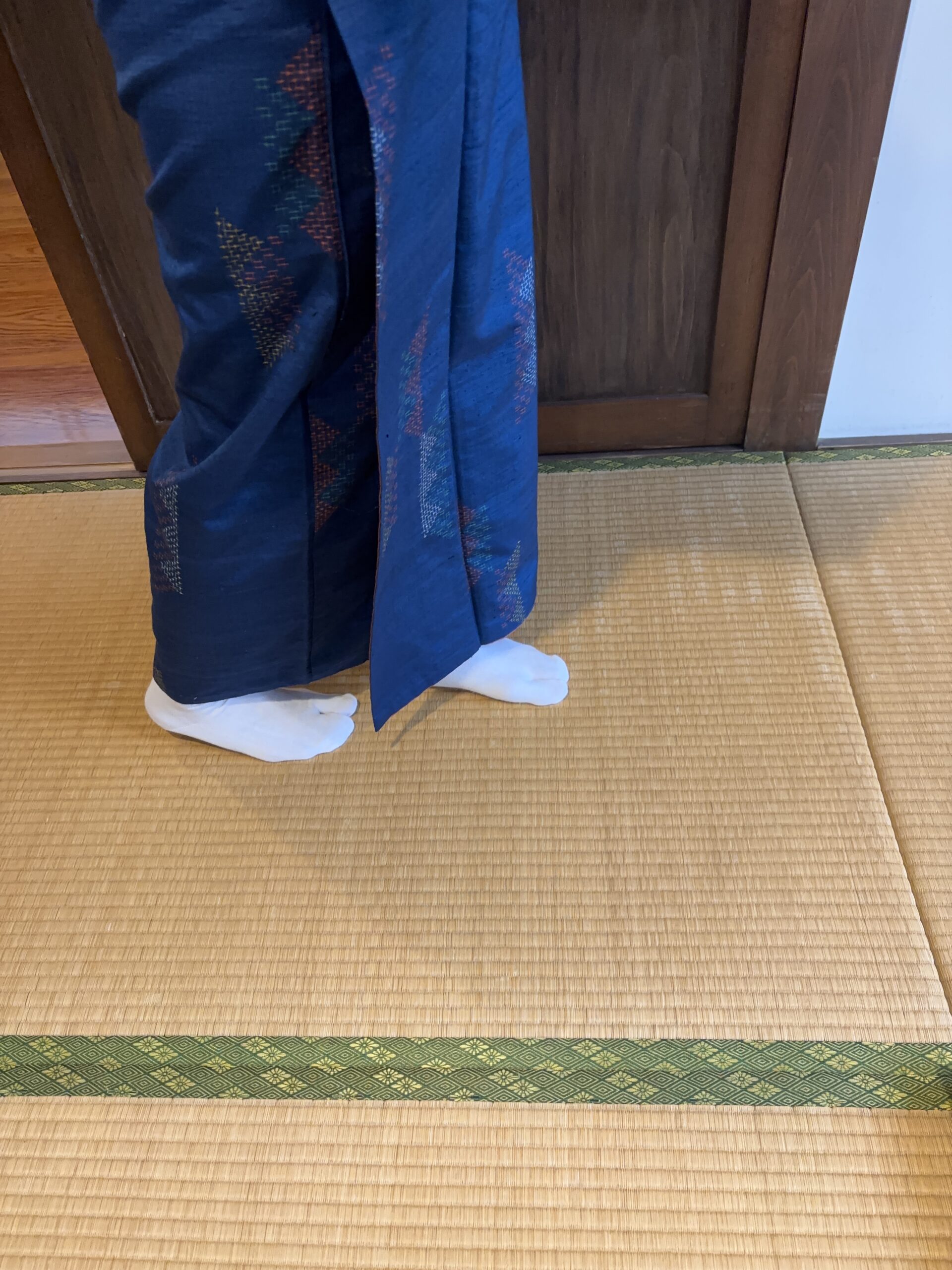
It’s true that a kimono hem narrows below the ankles, making long strides difficult. But if you really wanted to, you could run. For example, if you were being chased by a furious bear.
So let’s consider some more realistic reasons.
Reason 1: Protecting Precious Tea Utensils
When walking during a tea ceremony, the host is often carrying utensils. Some tea utensils are hundreds of years old and extremely valuable. (Sadly, none of the utensils at our salon fall into that category.)
Before Rikyu established the tea ceremony as we know it today, many utensils used in tea gatherings were imported items. At the time, imported goods were quite rare, made with extraordinary techniques, and unimaginably beautiful to Japanese people of that era.
If you tripped, fell, or stepped on such precious objects, they would be ruined instantly. And if you broke a lord’s treasured tea utensil, it might not have ended with just seppuku—you and your entire family could have been executed.
That thought is terrifying, but it helps explain the logic:
When you are carrying something precious, you naturally move slowly and carefully. Just considering this point alone, walking with small, deliberate steps makes perfect sense.
Reason 2: Keeping Dust from Rising
Around the time of year-end cleaning, Japanese news sometimes shows how large temples in Kyoto clean their tatami mats.
For example, at Higashi-Hongan-ji Temple, enormous halls are covered with hundreds of tatami mats. How are they cleaned? The temple followers, staff, and high school students beat the mats with thinly split bamboo sticks. Dust rises into the air, at the same time, they use huge fans to blow it outside. You can see the news here!
Traditionally, tatami are made by tightly compressing straw into a core, then stitching woven rush grass on top. They are not simply rush mats placed on wooden floors. Thanks to the straw core, tatami have a unique texture—softer than wood, but firmer than carpet.
Both straw and rush grass are plant stems. When rush grass are woven, a three-dimensional pattern emerges. Using tatami for a long time, fine dust could get trapped inside, and when the surface is struck hard, the dust would rises up.
(By the way, at our salon, we clean our tatami with vacuum cleaners, brooms, and cloths.)
Before a tea ceremony, the tatami are cleaned carefully because utensils and tea bowls are placed directly on them. And to be extra cautious, people avoid stomping heavily on the tatami so that dust does not rise into the air.
From this perspective, the small, quiet way of walking may have developed as a form of etiquette—to prevent dust from floating up. When both the host and the guests naturally share this manner of walking in the tea room, they together create a clean, calm space where delicious matcha can be enjoyed.
If you can think of any other possible reasons for this unique way of walking, please let us know!
Feel tatami with your feet, and tea with your heart.