Tea Ceremony Club (2): How Is Tea Ceremony Learned?
How Do You Learn Tea Ceremony? Observation, Repetition, and Silence
One of the biggest mysteries surrounding the tea ceremony is how it is taught.
Even in Japan, most people have never practiced the tea ceremony. In fact, a 2021 report by Japan’s Agency for Cultural Affairs revealed that nearly 70% of people surveyed had never experienced one at all, and many of those who had were no longer practicing. So if you’re wondering how one actually learns the tea ceremony—especially if you’re reading this from outside Japan—it probably feels like a bit of a mystery.
So how does one learn the tea ceremony? For me, it began as a school club activity.
Starting Without Understanding
When you first join a tea ceremony club, you understand almost nothing.
You are given a fukusa-basami, a small cloth pouch that holds your basic tools: a folding fan, a silk cloth (fukusa), paper (kaishi), and a small sweets knife. This knife is not sharp at all—it has a rounded blade, designed only for cutting soft confections, and is sometimes even used to pick up a sweet and bring it to your mouth. At first, all of these objects feel mysterious. You don’t know what they are for, or how to use them.
The teacher doesn’t explain everything at once. Instead, you are told what to do, step by step.
“Place your fan here.”
“Bow slowly.”
“Let your hands slide naturally back to your knees.”
Even walking and bowing have detailed rules. How many steps you walk on the tatami, how to form your hands, how slowly you move—everything matters.
Learning Through Parts: Wari-geiko
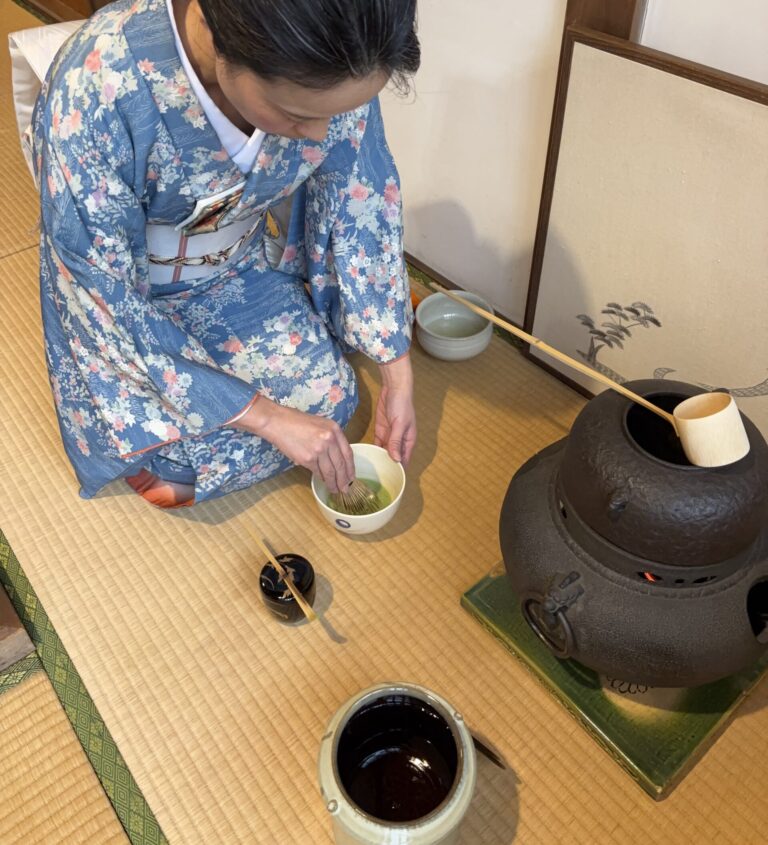
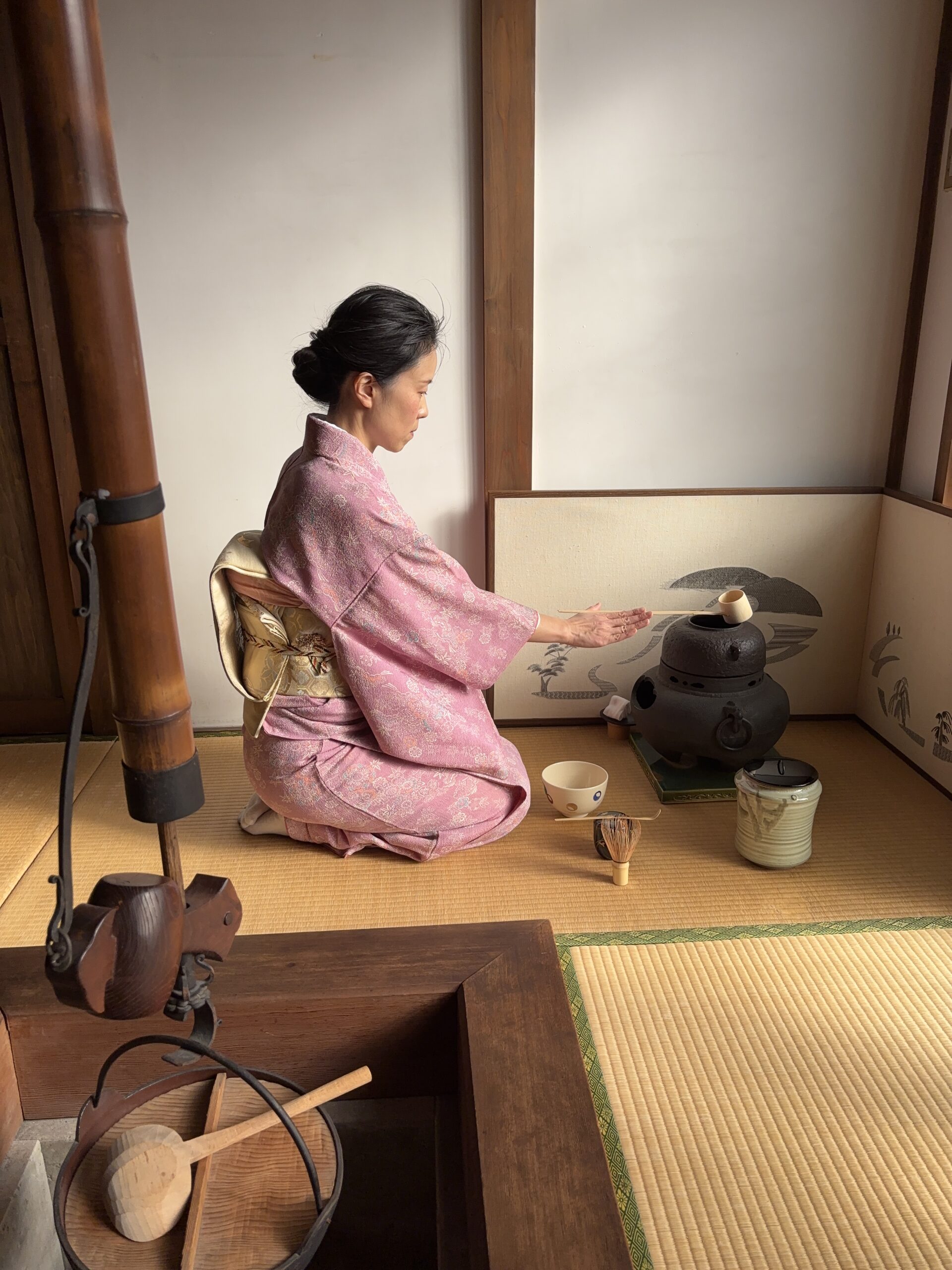
Tea ceremony movements are broken into small parts called wari-geiko, or “split practice.” You don’t perform a full tea ceremony at first. Instead, you practice walking, holding the silk cloth, or handling the tea whisk.
This method is similar to practicing scales in music or basic drills in sports. You repeat the same motions again and again until they become natural.
Watching Is Studying
Much of your time is spent watching senior students perform otemae, the matcha-making procedure.
You are told, “Don’t just look—observe.”
If you don’t focus, you won’t remember the movement.
Then, suddenly, it’s your turn.
You forget tools. You pick up the wrong object. You freeze. Your hands stop moving. And every time, the teacher calmly tells you what comes next.
Our tea teacher usually came only once a week. On other days, students practiced by themselves, guided by other members. Mistakes were normal. Repetition was endless.
This way of learning—through silence, observation, and repetition—is very Japanese, isn’t it? And slowly, without realizing it, your body begins to remember.
In the tea ceremony, practice never truly ends. The same lessons return, day after day, in silence and repetition. In the next post, I’ll continue my school-day story in the next post.