Questions About Sado, the Tea Ceremony: Why Don’t Matcha Bowls Have Handles?
If you have ever seen a Japanese tea ceremony, you may have wondered: Why doesn’t a matcha bowl have a handle?
Coffee cups have handles. Mugs have handles. When you are drinking something hot, a handle seems like a very sensible thing to have. So why do Japanese matcha bowls look so different?
Tea Cups in Europe Did Not Always Have Handles
Here is something I find surprising: European teacups did not always have handles, either.
When tea became popular in Europe in the 17th century, tea and teaware were being brought from China. Small handleless cups were also used in Europe, and the familiar handled teacup developed later.
So it is not quite as simple as saying, “Western cups have handles, while Japanese tea bowls do not.” The history of tea and teaware is much more interesting than that. Tea travelled from China to Japan, and to Europe, and teaware travelled along with it.
How Tea Became Part of Japanese Culture
Tea is thought to have arrived in Japan from China around the 8th century. For a long time, however, tea was enjoyed by only a relatively small part of the population.
In the early 13th century, the famous Zen monk Eisai wrote a short book about the benefits of tea. When he recommended tea to a shogun suffering from a hangover, the shogun apparently enjoyed it—and tea drinking gradually became more widespread.
By the 16th century, tea had become popular beyond the upper classes. At the famous Kitano Grand Tea Gathering in Kyoto in 1587, hundreds of tea pavilions are said to have been set up, with estimates ranging from around 800 to 1,500.
One of the most important people who helped shape the tea culture we know today was Sen no Rikyu. His ideas about tea, including the way tea was prepared and the beauty of simplicity, had a profound influence on the development of Japanese tea ceremony.
Many of the movements and utensils used in tea ceremony today have their roots in this long history.
And this brings us back to the tea bowl.
The Bowl Needs to Be Big Enough for the Whisk
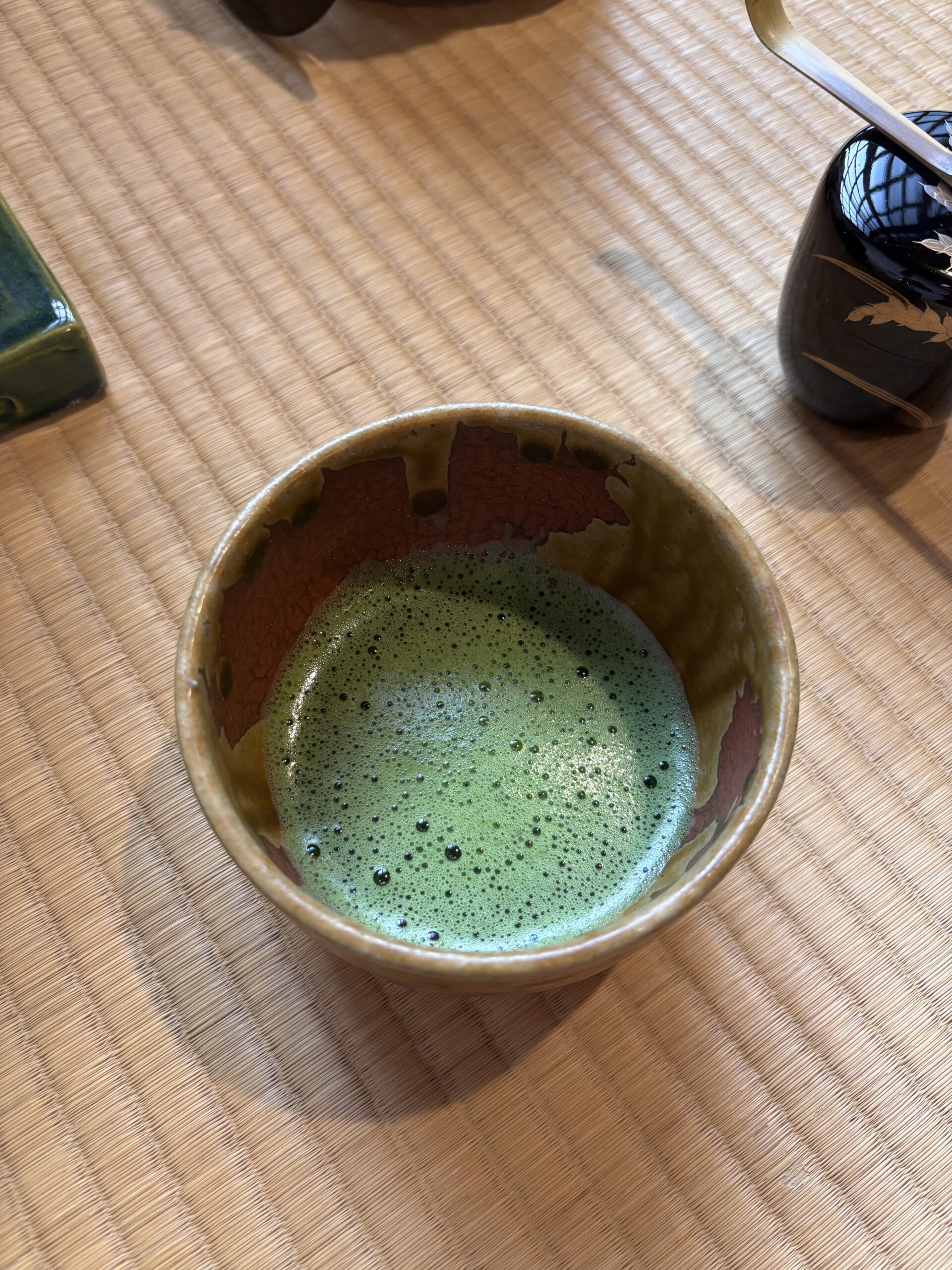
Matcha is powdered tea, and in the tea ceremony, it is prepared directly in the bowl. Hot water is added to the powdered tea, and the mixture is whisked with a bamboo tea whisk, or chasen.
The whisk is made of delicate bamboo, which is gentle enough to use inside a pottery bowl without damaging it. Because the size of a standard chasen is fairly consistent, the bowl needs to be large enough for the whisk to move freely.
This is one reason why a matcha bowl is much larger than an ordinary Western teacup.
Now imagine putting a handle on such a large bowl.
If there were only one handle, it would have to support the weight of the bowl itself as well as the hot tea inside. You can imagine what might happen if the handle suddenly snapped off while you were holding it!
What if we added two handles instead? That might make the bowl easier to hold, but it would create another problem.
In tea ceremony, you do not simply pick up the bowl and drink from whichever side happens to face you. Before drinking, you turn the bowl slightly so that you do not drink from its front—the most beautiful or important part of the bowl.
With two handles, drinking from the side would be difficult. Perhaps if tea bowls had always had handles, this small but graceful gesture would never have become part of tea ceremony etiquette in the first place.
Of course, practical considerations are only part of the story.
Beauty Matters, Too
The beauty of the bowl is perhaps even more important. A matcha bowl is not simply a container for tea. It is also something to hold and appreciate.
You hold the bowl with both hands and feel its weight. You notice its shape, its texture, the colour of the glaze, and the way the light falls on its surface. A tea bowl is something to experience not only with your eyes, but with your hands.
Perhaps this is one reason why a handle is not necessary. Instead of holding the bowl by a separate handle, you hold the bowl itself.
You Look at the Bowl After Drinking
Once you pick up the tea bowl, please drink it without delay. It’s hot, so there’s no need to rush, but it tastes better that way.
After finishing the tea, you may then have an opportunity to look carefully at the empty bowl and appreciate it.
This practice is called haiken—literally, viewing or appreciating something. You look carefully at the shape, the glaze, and the details you may not have noticed before.
In this way, the tea bowl is both a vessel for drinking and an object to appreciate. The experience does not simply end when you finish the tea. You have another moment to look at and appreciate the bowl itself.
Experience It at Oh! Mama
When you experience a tea ceremony with me, you can hold the bowl in both hands, feel its weight and texture, and take a moment to appreciate its character.
Why not enjoy matcha with a handle-less tea bowl with us?