Questions about Shodo, Japanese Calligraphy: Smooth or Rough?
Even people who learned calligraphy at school as children sometimes wonder about this.
Which side of the paper should you write on—the smooth side or the rough side?
The answer is simple:
Choose the side you like.
Some of our guests have a particularly sensitive sense of touch and notice even very small differences.
The Japanese paper we use for our Shodo experience is very thin. When guests touch it for the first time, they sometimes accidentally pick up several sheets together, thinking they are holding just one.
Then, when they separate the sheets, they often notice something:
“Oh, this side feels smooth, and the other side feels rough!”
Exactly.
Traditional Japanese paper, or washi, is dried by attaching one side to a smooth board. The side that touches the board becomes smoother, while the other side retains a slightly rougher texture.
So, which side should you use?
For beginners, we usually recommend the smooth side.
Most of our guests are trying Shodo for the first time. So when they ask us which side to use, we usually say:
“Try the smooth side. Your brush will move more easily across the paper.”
And it is true. The brush glides more smoothly, making it easier to control the movement of the brush and the amount of ink.
But when professional calligraphers visit us, we sometimes hear a different answer:
“Try the rough side. It can be intriguing.”
Why?
The rough side can create beautiful imperfections.
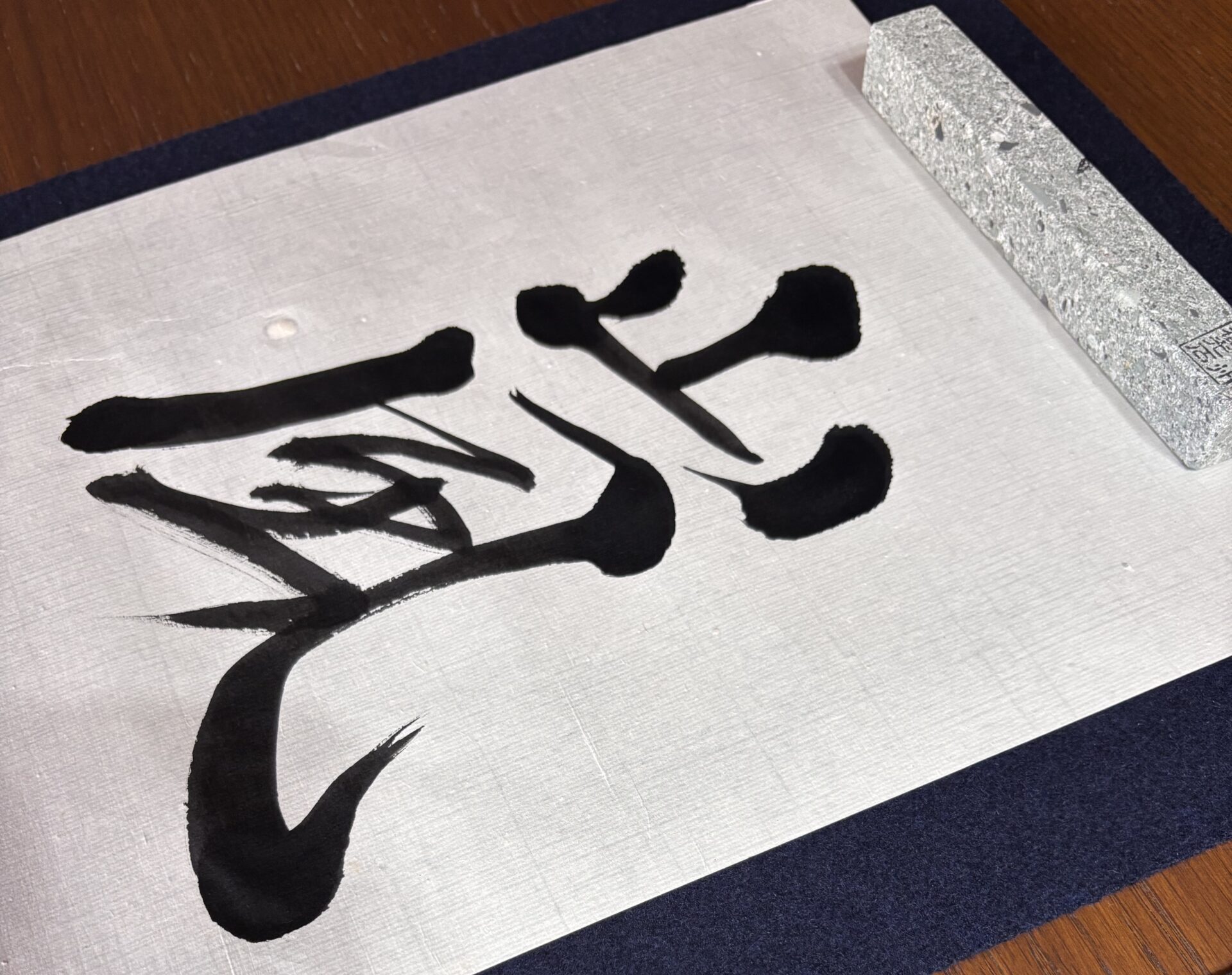
According to calligraphy artists, writing on the rough side makes it easier to create bleeding and dry-brush effects.
Shodo is an art of writing. But if the only goal were to produce neat, perfectly formed characters, typing them on a computer and printing them would be much easier.
In fact, there are countless Japanese digital fonts today, including fonts designed to look like calligraphy.
But that would take away much of the fun.
When you write by hand, the character can change depending on the movement of your brush. The size of the character. Its angle. The thickness and thinness of each stroke. The way ink spreads into the paper, creating a soft, generous bleeding effect. Or, on the contrary, the way a fast or forceful brush movement leaves parts of a stroke dry, creating kasure, the beautiful dry-brush effect. These details can make a character feel energetic, powerful, or even a little wild.
That is why calligraphy artists sometimes choose the rough side.
They are not simply trying to write a “beautiful” character. They are looking for something with character. And perhaps that is one of the joys of Shodo.
Instead of simply trying to write neat and perfect characters, why not discover the unexpected beauty that can emerge from your brush?
Come and discover your own expression through Shodo at Oh! Mama in Tokyo.