A Question About Shodo, Japanese Calligraphy: Do You Count the Rhythm When You Write?
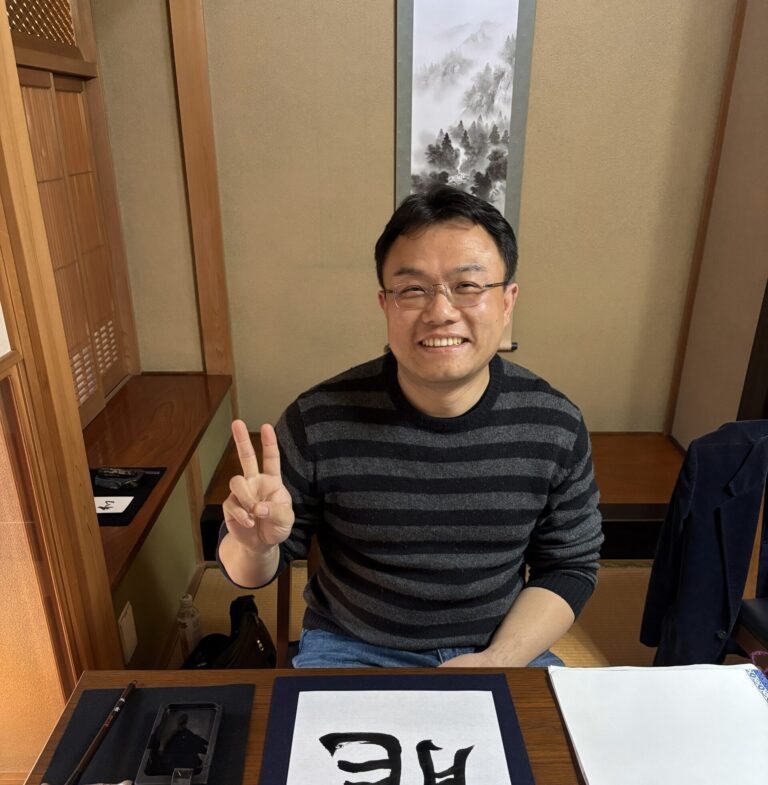
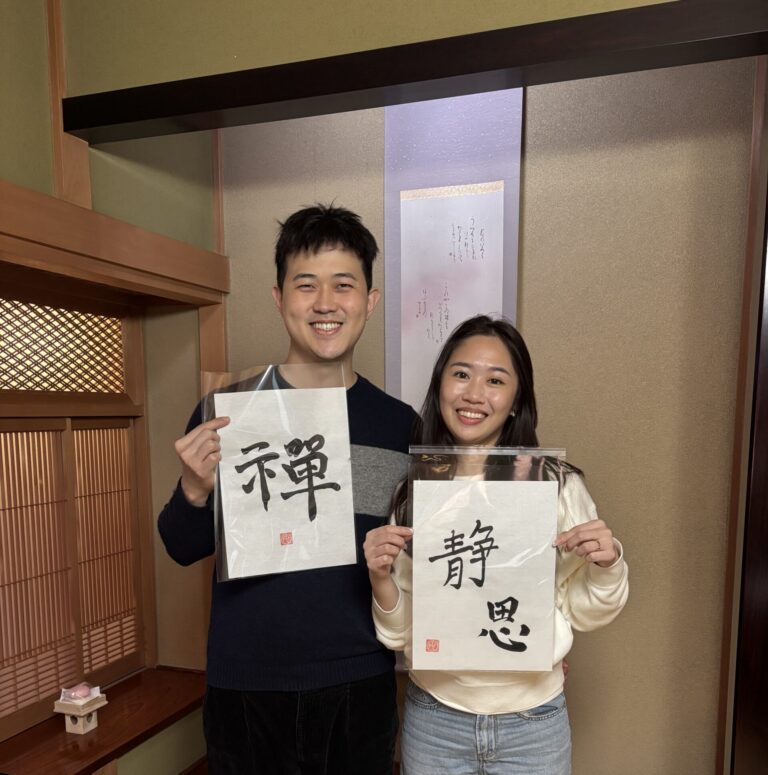
Most of the guests who join a calligraphy experience at Oh! Mama are trying shodo (Japanese calligraphy) for the first time. Some have tried it a few times before, but that was many years ago.
To help everyone enjoy the experience, I begin with a short introduction to the basics.
By “the basics,” I mean the kind of calligraphy that almost everyone who went through elementary school in Japan learned in their childhood.
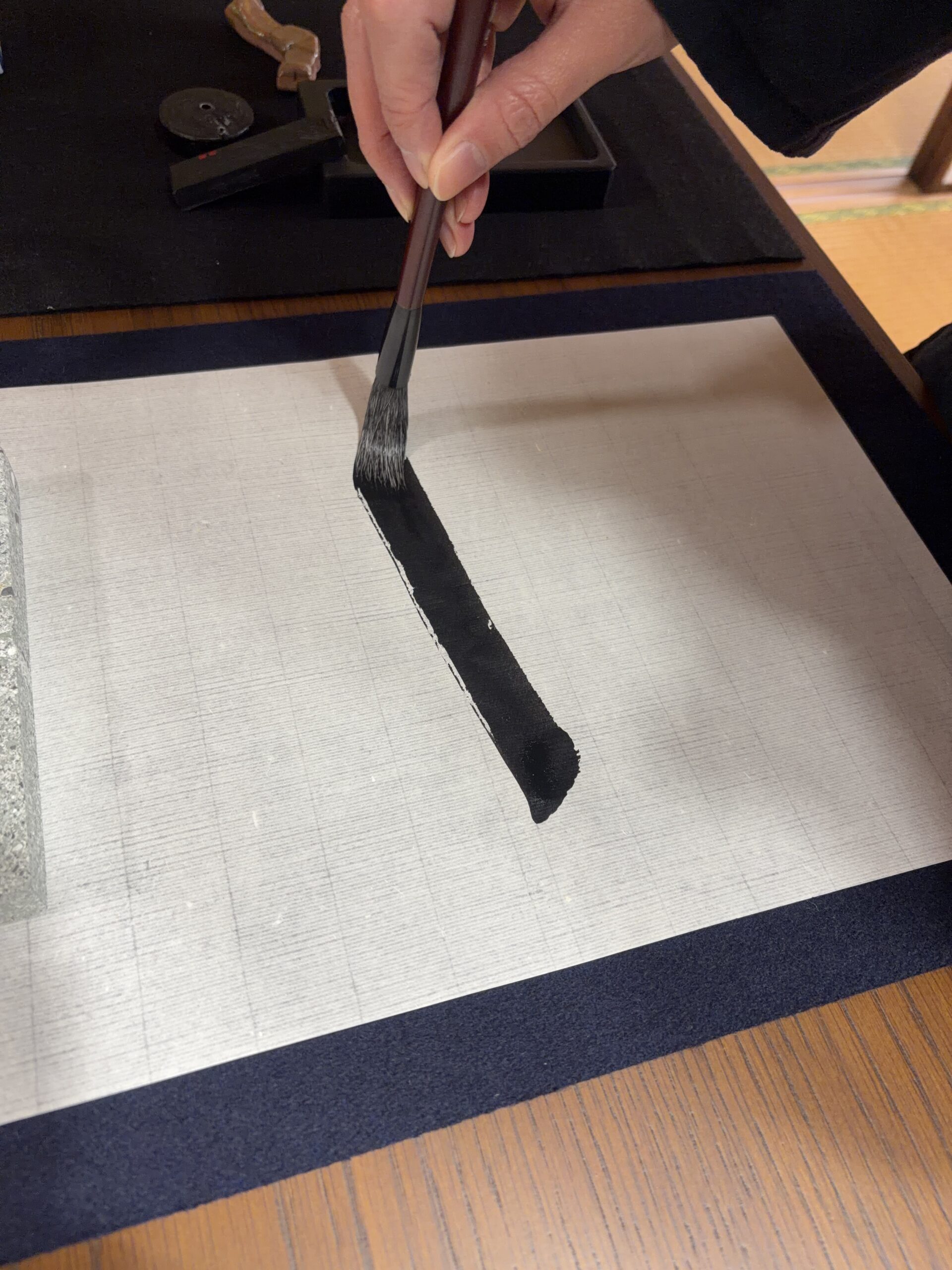
The very first character we practice is 一 (ichi), which means “one.” It is simply a horizontal line.
When learning to write this line, children in Japan are sometimes taught a rhythm expressed as “Ton, Tsuu, Ton.”
The first “Ton” is like gently tapping someone on the shoulder or softly placing a cup on a table. It gives us the image of gently touching the paper with the brush.
“Tsuu” brings to mind something sliding smoothly across a surface, or a tear slowly running down someone’s cheek. It is the feeling of the brush gliding across the paper.
And finally, another “Ton.” Since the brush is already touching the paper, this is the moment to stop its movement.
Following these simple movements helps us create a beautiful, well-balanced line.
To make this rhythm and movement easier to understand, I explain it to my guests using a count of four.
On 1, place the brush on the paper.
On 2, move the brush to draw the line.
On 3, stop the brush.
On 4, lift the brush from the paper.
One guest once said, “It’s like dancing!”
Another guest quietly counted “1, 2, 3, 4” while carefully writing each stroke. Every character they wrote, with attention given to each individual movement, turned out beautifully.
But wait a minute. When we watch an experienced calligrapher creating a piece of work, the movements of the brush seem much more varied. There are changes in speed and intensity, and the strokes certainly don’t seem to follow a simple “1, 2, 3, 4” rhythm.
And yet, doesn’t it still look like a dance?
When we learn music, we often start with a simple four-beat rhythm: 1, 2, 3, 4. As we move on to more challenging pieces, we learn to fit several notes into one beat, vary the volume and intensity, and change the tempo. Sometimes we hold a note for a little longer, allowing it to linger in the air.
Shodo is much the same.
Once you have learned the basic movements, you can gradually become more expressive. You can move the brush slowly or let it sweep across the paper with energy. You can change the pressure or release it. Even within a single stroke, there can be variations in speed and strength.
When you watch a skilled calligrapher closely, you may notice that every moment has its own meaning: the instant the brush touches the paper, the time it travels across the surface, and the moment it lifts away.
Of course, experienced calligraphers don’t actually count “1, 2, 3, 4” in their heads. Through years of practice, these movements become part of their natural sense of rhythm and flow.
For someone trying shodo for the first time, however, counting four beats is a small but helpful way to discover that feeling.
First, place the brush. Draw the line. Stop. Lift the brush.
Enjoy each movement, one at a time, and let your brush move across the paper.
Perhaps one day, our brushes will begin to dance to their own music.