A Calligraphy Curiosity: “Ugatsu Homura”
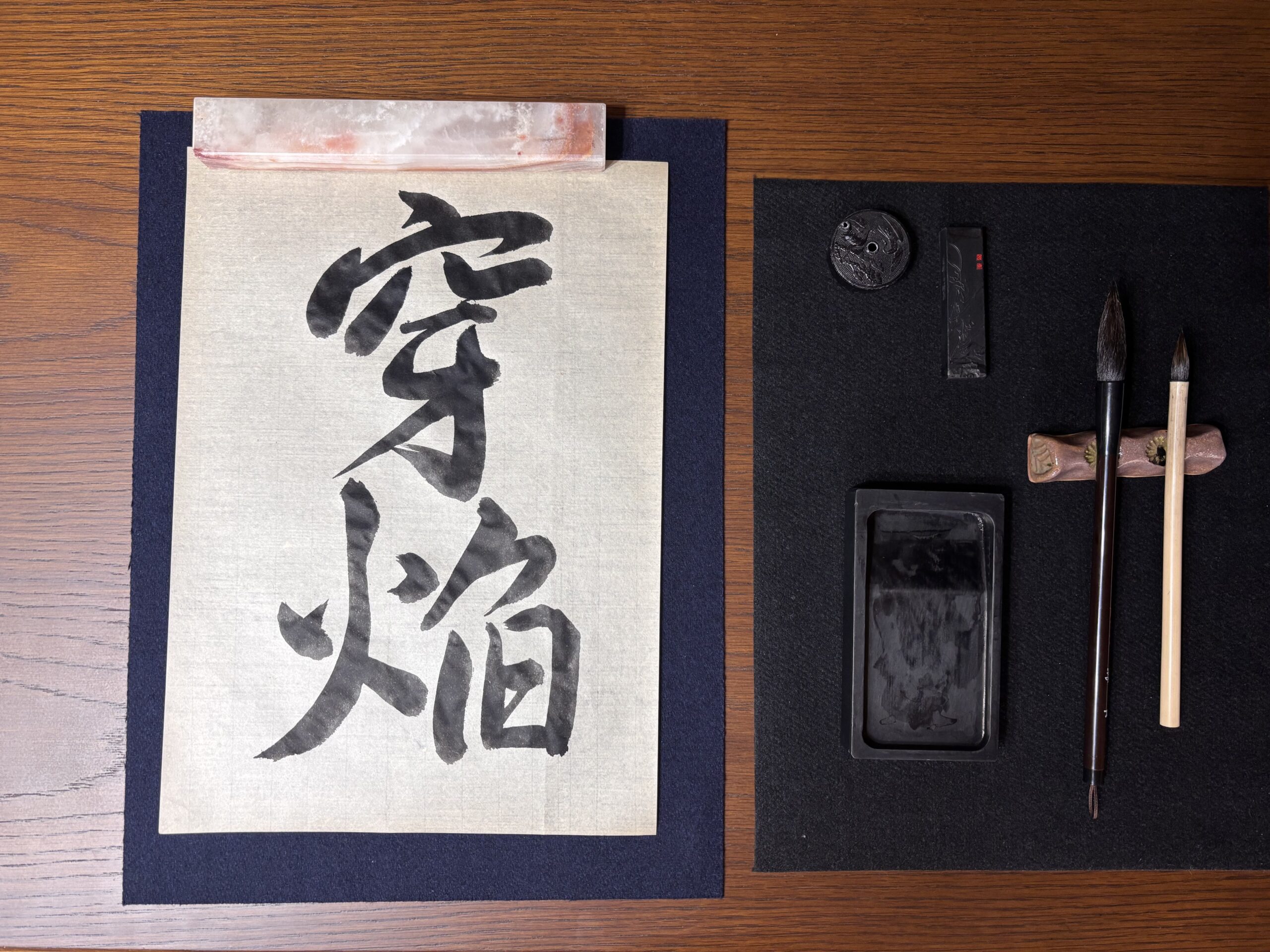
Recently, a word kept echoing in my mind—Ugatsu Homura. My 8-year-old son had been repeating it over and over, inspired by a character from Pokémon.
What caught my attention is that both ugatsu and homura are native Japanese words (wago)—terms that have existed in the Japanese language since ancient times. Before putting brush to paper, I’d like to take some time to reflect on the meaning of these words and explore the structure of each kanji in greater depth.
What Does “Ugatsu” Mean?
The verb ugatsu (穿つ) means to pierce or to dig a hole. It carries a very physical and concrete image.
If we look at the kanji 穿, its structure is quite expressive: the element for a hole (穴) and a fang or tusk (牙). Together, the character visually conveys the idea of drilling or penetrating deeply.
This meaning also appears in a common expression:
“ugatta mikata wo suru” (穿った見方をする)
This phrase means to perceive the essence of things deeply—to grasp subtle truths that are not immediately visible. It is actually a compliment, describing someone insightful and perceptive.
For a long time, I misunderstood it. Because ugatsu sounds similar to utagau (疑う, “to doubt”), I assumed it meant something like a skeptical or suspicious viewpoint. That interpretation is completely wrong. Discovering this through a dictionary was a small but meaningful lesson for me.
Another idiom using the same verb is:
“Amadare ishi wo ugatsu” (雨だれ石を穿つ)
Dripping rain water hollows out stone.
This expresses the idea that small, continuous efforts eventually produce results—a beautiful and encouraging image.
What About “Homura”?
The word homura (焔) means flame or blaze. Flame can also be pronounced honoh and written with the more common character 炎, which is part of the standard set of everyday-use kanji in Japan.
The character 焔, however, is not listed in this common kanji set. If someone showed me this single character, I must admit—I probably wouldn’t be able to read it right away.
Interestingly, the nuance changes to me depending on the reading:
honoh (ほのお) → a straightforward image of fire or flames
homura (ほむら) → a more poetic, almost mystical image of strong, flickering, living fire
The answer became clear when I looked it up in a Japanese dictionary. The word homura can also refer to emotions—such as anger, resentment, or jealousy—burning within the heart.
In other words, homura is not only a physical flame, but also an inner, emotional fire.
The structure of 焔 is also interesting.
On the left side of this kanji is the radical for “fire” (火), while the right side is said to indicate the Sino-Japanese (Chinese-derived) reading “en.”
Language, Imagination, and Modern Culture
In Pokémon, Ugatsu Homura appears to be a fire-related character. Knowing the meanings behind the words, one might imagine a flame that pierces or bores through—a vivid and dynamic image.
It makes me wonder: will this character one day demonstrate a technique that embodies the idea of ugatsu—penetrating deeply or breaking through?
A Small Reflection
This experience reminded me that even familiar sounds can hide unexpected meanings. Sometimes, a word from a child’s favorite TV anime can open a small window into the depth of the Japanese language—and into the art of calligraphy.
Experience Japanese Calligraphy in Tokyo
Curious about Japanese characters?
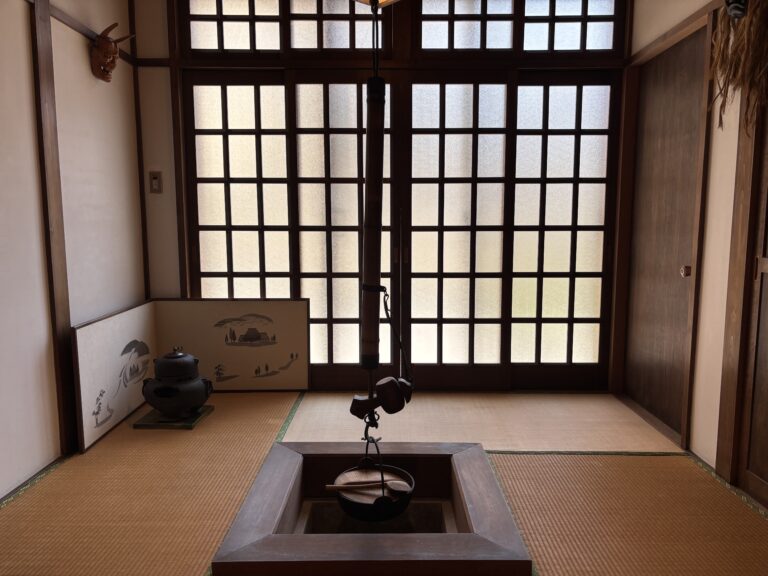
✨Oh! Mama is a traditional Japanese house located in Ikenoue, a peaceful residential neighborhood near Shibuya.
We offer private shodo, calligraphy and sado, matcha tea ceremony experiences guided in English by a nationally licensed professional guide-interpreter.