Questions about Sado, the Tea Ceremony: What Is Written on a Tea Fan?
During the Japanese tea ceremony, you never open a folding fan.
Being told not to open something, of course, makes you want to open it—that’s human nature.
And yet, because tea fans are never opened during the ceremony, I honestly don’t know what is written on other people’s fans.
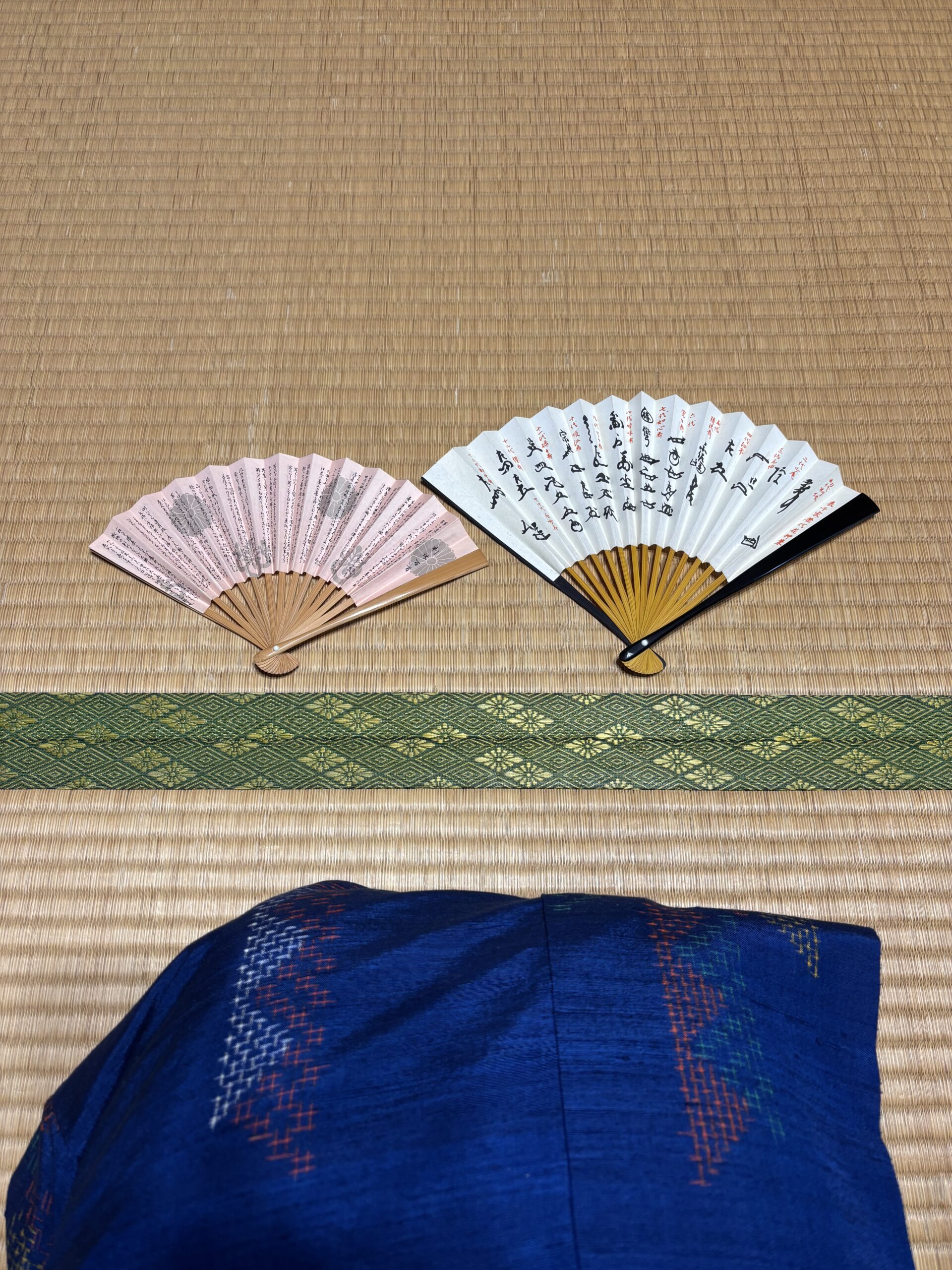
I own two tea fans myself. One is a small fan my teacher gave me when I first began studying tea ceremony. The other is a black lacquered fan I received later, after I started attending lessons at my teacher’s home.
Rikyu Hyakushu: One Hundred Poems of Tea
The smaller fan contains Rikyu’s One Hundred Poems (Rikyu Hyakushu). Sen no Rikyu, the tea master who established today’s tea ceremony style in the 16th century, expressed the essential spirit of tea in one hundred short poems written in the traditional tanka form of thirty-one syllables.
You might wonder how one hundred poems could possibly fit on such a small fan.
They do—fifty poems on the front and fifty on the back.
I had the opportunity to study this fan together with my tea teacher in a tea room, opening it as part of the lesson. However, this fan is not something that is opened during a tea gathering or while performing tea procedures.
I do not yet fully understand all of the poems myself, but I hope to continue learning and to gradually share what I discover in future blog posts.
Kao : Signatures of the Tea Masters
The other fan, the lacquered one, is a collection of kao, or signatures, from successive heads of the Omotesenke school of tea—from Sen no Rikyu through the 14th generation. A kao is a design of the name as a single character.
While I don’t own utensils signed by the grand masters, tea teachers often do, and such pieces can also be seen in museums. It’s always possible to ask whose seal it is—but comparing it with a seal collection and discovering it yourself brings a quiet kind of joy.
Why Is a Fan So Important?
When I first began studying tea ceremony, I was given a small bag for utensils—and inside it was a fan. From the very beginning, I learned that the fan is one of the essential tools of tea.
It has two main roles:
one is used when bowing, and the other is as a marker for one’s seat.
Japanese culture places great importance on bowing. We bow far more often than we exchange spoken greetings. A bow always involves another person, and by lowering oneself physically, one expresses respect.
In a tea room, there are no steps or raised platforms. The host and guests all sit on the same level of tatami mats. By placing the fan horizontally in front of oneself, one quietly expresses, “I am lowering myself before you.” It is a simple gesture, but a meaningful one.
The Fan as a Seat Marker
A tea room is a very simple space—just tatami mats, and very little else. When you reach your place, you set your fan behind you. This marks your seat.
When a bowl of matcha is prepared, guests move forward to receive the bowl. If there is an assistant called hanto, the bowl is carried to the guest. If not, the guest stands and walks to receive it themselves.
Once, a guest asked me, “Isn’t it against hospitality for guests to stand up and fetch their own tea?”
It’s a fair question.
But in tea ceremony, the host is not the only one who plays a role. Guests also have responsibilities: how to bow, how to take sweets, how to drink the tea, how to admire the bowl, and how to return it. In this sense, guests are not passive recipients, but participants—helping to create the gathering together.
Perhaps this shared awareness, this quiet mutual understanding, is one of the enduring values of the tea ceremony.
One Last Thing to Remember
From the moment you enter the tea room until you leave, the fan is never opened.
No matter how hot the day may be, even if you are holding a fan, you should never open it to cool yourself inside the tea room. In the tea room, fans remain closed.
At our tea ceremony experience, we provide guests with traditional tea fans. You don’t have to worry—we won’t blame you if you open one. You’re welcome to look.
All we ask is that you treat it with care.
If you’re curious about tea ceremony—or calligraphy—and would like to experience them in a quiet Japanese house, we would be happy to welcome you.